

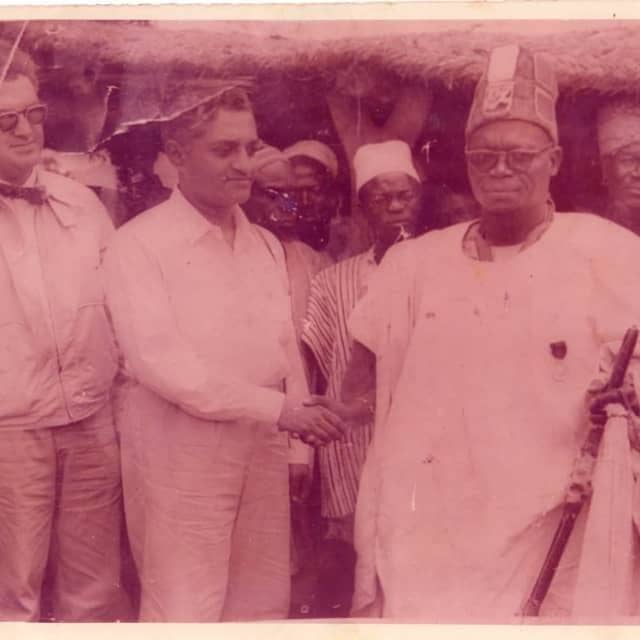
Naa Bagamsa Dimongso was born in the year 1904 to Mr. Dimongso, a wealthy farmer and Mamprusi royal, in Binde, the Pibri Traditional Capital. He received informal training from his father and other extended family members and, in 1920, he was enrolled in Gambaga primary school and became the first Educated Paramount Chief in the Mamprugu kingdom.
Naa Bagamsa Dimongso was one of the brightest students in his class and was promoted quickly and, by 1921, he was enrolled into the then middle boarding school in Tamale. He completed middle boarding in 1926 and again got enrolled into Tamale trade school in 1927.
Owing to his chiefly moral upbringing and his fine academic prowess, by 1932, he was the personal secretary to the Nayiri. As the secretary to the Nayiri, he was the official mouthpiece of the entire Mamprugu kingdom. He worked with the Mamprugu Area Council between 1932-1949, translating the policies and programs of the colonial administration to the Mamprugu kingdom and conveying the concerns and aspirations of the Kingdom to the colonial administration (indirect rule).
Naa Bagamsa Dimongso was one of the prominent chiefs and representatives of chiefs who, in 1946, formed the Northern Territories Council (NTC) – the first of its kind in the three northern regions – to represent the interest of the peoples of the north in the colonial administration. The NTC wrote petitions to the colonial administration to bridge the economic gap between the north and the south. It is noteworthy that the NTC was part of the indirect rule system by the British who recognized chiefs as natural rulers and the Northern Territories Council was the highest decision-making body in the north that oversaw processes leading to independence.
Pib-Raana, the late Naa Bagamsa Dimongso, was again part of the chiefs and representatives of chiefs who formed the Northern Peoples Party (NPP) in 1953, a precursor to the modern-day New Patriotic Party (NPP), to represent the interest of the chiefs and peoples of the north and to ensure that peoples of the north were part of the political development leading to the attainment of independence in the near future.
In the 1954 elections, the Northern Peoples Party (NPP), formed by chiefs with Pib-Rana, Naa Bagamsa Dimongso inclusive, won the second largest number of seats to parliament. The Northern Peoples Party (NPP) became the official opposition party with Nkrumah’s CPP as the Majority. They were elected through an electoral college and Naa Bagamsa Dimongso won 29 votes that, for the first time, saw a chief from Mamprugu in parliament. He went to the legislative assembly with the following other chiefs from the north: Tolon Naa Yakubu Tali, J. H. Alhassan, A. Afoko, Seidu Wala, Alidu Kanton, Ayarna Imoro, S.D. Dombo, L.R. Abavana, Abudu Mumuni etc.
Nkrumah’s CPP and NPP from the people of the north, together, laid the foundation for the broad lines of Ghana’s political independence. Four members of the Northern Peoples Party, to which Naa Bagamsa was a member, were part of the Coussey Committee that drafted the constitution for Ghana’s independence. Our beloved father played a very significant role that led to the liberation of our people from the shackles of colonial rule to self-governance.
Our beloved grandfather ensured a major trunk road was constructed from Nalerigu through Nakpanduri-Binde-Bunkpurugu for the first time to further boost economic activities within the area. During his reign as the Paramount chief of the Pibri Traditional Area, Binde was the heartbeat of academic excellence. It is evident that many people from Bunkpurugu, Nakpanduri and all the surrounding communities attained education through Binde.
Mamprugu have produced great men who have served this nation in various capacities.